Veckans Ledare

John Mortimer has almost 20 years experience in the private and public sectors, and has learned to use systems thinking and complexity to create innovative ways of working. John is part of the Human Learning Systems Network and he has worked with a range of local and central government services where he has helped them to develop citizen centred ways of working, helping to bring people together to work in cross-functional teams. John also runs workshops to help others to use these methods.

Ledarskap för den moderna komplexiteten.

JM September 2022

One of the reflections that we know is, rather than change being a project that we do from one date to the end, we are recognising that the workplace is more and more becoming a place where change is constant.

This is an interesting point. 

When we are stable we work one way; procedures instruct us, measures guide us, and people do the things they have on their job description.

And when we ‘do change’ we work another way. We plan, decide, develop a programme, and implement.

Trying to jump between one and the other seems to be unstable, difficult, stressful, and often contradictory. 

The Flexibility we Actually Need
Looking at how progressive organisations we can observe that those working in them have different characteristics. 

Traditional Management and Leadership

This focuses on clear departments, with employees working in their roles as described in the job descriptions. The work is standardised and described by procedures. Periodic audits are carried out to ensure this is constant. Leaders use high level measures.

This approach appears to work well, except for the fact that when you actually look into these organisations, it does not really work that well. The culture often becomes one of ‘managers tell’ and ‘workers do’. Innovation has to be done in a room, separate from the workplace. And HR have to come up with ways to motivate employees. 

Progressive Management and Leadership

Imagine an organisation where front line staff can deal with customers, and decide what they need to do and how they should do it. They can easily pull for support from their managers or experts when they need to.

In this alternative working environment, the real change is in what leaders and managers do and how they behave. They are less glued to their measurement screens and writing reports, they are out and about learning what is happening in the workplace. They are engaged with customers and see first hand the impact their staff have on customers and the operations.

They witness the teamwork across the organisation. They engage horizontally across the workflow,
and vertically with senior managers. 
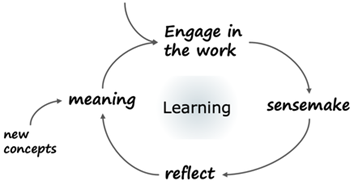
Mangers observe when things go well, and learn and support when they do not. They make sense of the various levels and dynamics that synthesise into a whole service.

The role of Managing and Leading is learning and acting with the staff to ensure that the organisation can learn and adapt